
FAN CULTURE & GEAR
Scarves and Fashion: When Soccer Meets Style
What Fashion Figured Out About Soccer Scarves
Soccer scarves became a fashion staple because they already did what great fashion does: signal identity, add bold color, and tell a story that belongs to the person wearing it.
You have seen them on runways in Paris. On sidewalks in Brooklyn. Draped over leather jackets in TikTok styling videos that have nothing to do with soccer. The soccer scarf figured out something the fashion world took years to notice. Bold color, real identity, and a story that actually means something to the person wearing it is a combination that works everywhere.
Fans already knew this. If you have ever thrown a scarf over your shoulders on the way to a match and caught a compliment from someone who could not name a single player on your team, you already get it. The scarf does not need an explanation.
It just works.
What changed is that fashion started paying attention. And once designers, streetwear brands, and celebrities got involved, the soccer scarf went from stadium staple to style piece. But the culture came first. It always does.
How did soccer scarves become a fashion trend?
Soccer scarves already had everything fashion looks for: bold color, strong pattern, and a built-in story. Designers like Vetements and Balenciaga brought them to the runway in the mid-2010s, but fans had been styling them for decades. Today soccer scarves show up in streetwear, on celebrities, and across social media as a go-to accessory that works just as well off the pitch as in the stands.
Why a Soccer Scarf Works as a Fashion Piece
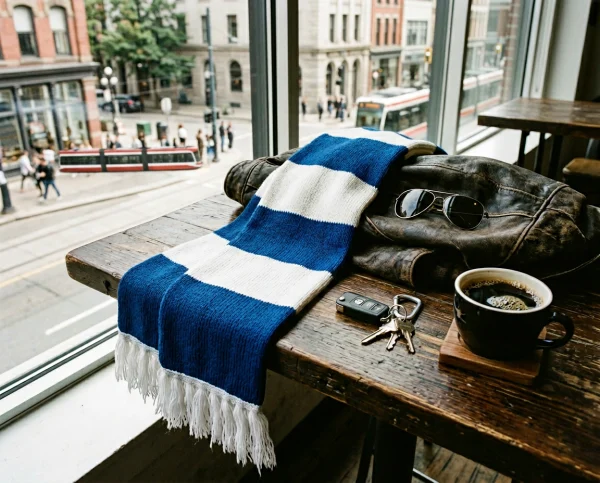
Most accessories try to add personality to an outfit. A soccer scarf already has one.Think about what a scarf brings to the table. Saturated color that pops against a neutral jacket. A bold graphic pattern that breaks up a plain look. And a built-in story that gives the person wearing it something real to talk about. That is not a fan accessory pretending to be fashion. That is what fashion has been chasing for years.
There is a reason streetwear thrives on identity. Logos, crews, limited drops, belonging to something. Soccer scarves had all of that before streetwear had a name. A supporters group scarf from a lower league club in Detroit or Chattanooga carries the same energy as a hyped brand collaboration. It signals that you are part of something and you are not shy about it.
It is not just scarves either. Soccer jerseys have been turning up on celebrities and in streetwear rotations for years. Pharrell in a Juventus kit. Bad Bunny in a Barcelona shirt. ASAP Rocky wearing a vintage Arsenal jersey like it came off a designer rack. The soccer aesthetic translates because it was always built on the same thing fashion runs on: color, crest, and loyalty to something bigger than yourself.
The scarf just happens to be the most versatile piece in that lineup. It layers. It drapes. It folds into a pocket or ties to a bag. And unlike a jersey, it works with almost anything you already own.
From the Terraces to the Runway
Fashion did not discover the soccer scarf. It borrowed it.
The crossover started picking up speed in the mid-2010s. Vetements put oversized soccer scarves on the runway in 2015. Balenciaga followed. Burberry and Versace worked soccer-inspired pieces into their collections. The pattern was always the same: take something fans had been wearing for decades, scale it up, charge ten times the price, and call it a moment.
But the real story was not on the catwalk. It was on the street. Soccer scarves started showing up in fashion week street style photos, draped over coats and tucked into outfits that had nothing to do with the sport. Stylists and photographers noticed what fans had always known. A scarf with strong color and a clean graphic holds its own against anything.
By the time the trend hit social media, the runway connection barely mattered. People were styling scarves their own way, mixing club colors with everyday fits, and posting the results. The scarf did not need a designer label to work. It just needed someone willing to wear it with confidence outside the stadium.
Soccer Scarves and Streetwear
The runway moment got the headlines. Streetwear is where the scarf actually lives now.
Scroll through TikTok or Instagram and you will find styling videos pairing scarves with bomber jackets, denim, oversized coats, and plain white tees. Most of these creators are not posting from the supporters section. They just think the scarf looks good. And they are right.
What makes it work in streetwear is the same thing that makes it work in the stands. It is bold without trying too hard. A vintage club scarf over a black jacket gives an outfit more character than most accessories ever will. The colors do the talking. The crest adds a layer of meaning even if the person wearing it could not tell you who plays left back.
American supporters groups are adding to this. Clubs like Detroit City, Forward Madison, and Oakland Roots create scarves with design quality that holds up next to anything in a streetwear shop. These are not mass-produced afterthoughts. They are intentional, limited, and made to be seen.
How to Style a Soccer Scarf
You do not need a styling guide to throw a scarf on. But a few approaches work better than others depending on where you are headed.
Going to a match. Drape it over your shoulders with both ends hanging in front. This is the classic look and it keeps the crest visible. When the moment comes, you grab both ends and hold it over your head. Simple.
The European knot. Fold the scarf in half, loop it around your neck, and pull the loose ends through. It sits clean against a leather jacket or peacoat and keeps things tight without looking overdone. This is the one most people end up using day to day.
Casual and layered. Let one end hang longer than the other over a denim or leather jacket. The asymmetry gives it a relaxed look that does not scream “I am on my way to a game.” It just reads like a good outfit.
The bandana fold. Fold your scarf into a triangle and wear it as a neck bandana. It is a little retro and a lot of fun if you have the right scarf for it. Thinner scarves work best here.
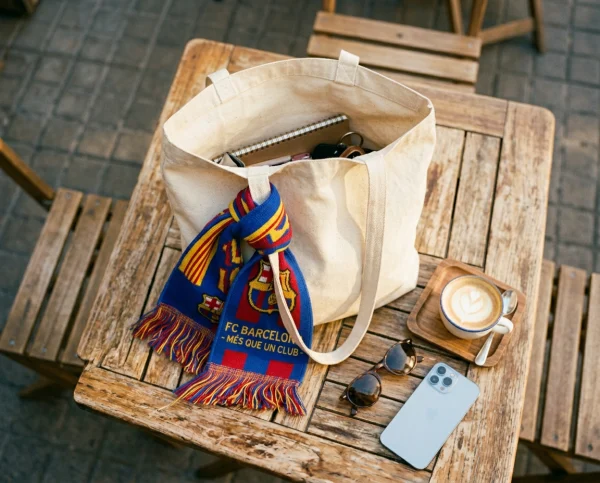
Off the neck entirely. Tie it to a bag strap for a flash of color on a neutral tote. Use a thinner one as a belt to break up a plain outfit. Fold one into a headband if you want to channel your inner Beckham at a summer watch party. The scarf does not have to live around your neck to do its job.
The only real rule is to let the scarf be the loudest thing you are wearing. Keep the rest simple and the colors do the work.
The American Scarf Moment Is Here
For a long time, scarf culture in the United States was borrowed. American fans adopted the tradition from England, Europe, and South America and made it part of the matchday experience. That was enough for a while. But something has shifted.
American supporters groups are not just buying scarves anymore. They are designing them. Clubs across every level of the pyramid are producing scarves with original artwork, local references, and design choices that reflect their own communities instead of copying what works in Liverpool or Buenos Aires.
Walk into a match in Sacramento, Chattanooga, or Detroit and you will see scarves that could hang in a design studio. These are not souvenirs. They are identity pieces built by people who care as much about how the scarf looks as what it represents.
And the timing matters. With the 2026 tournament coming to the United States, the audience for American soccer is about to get a lot bigger. A lot of new fans will be looking for a way in. A scarf is one of the easiest first steps. It does not require deep knowledge. It does not ask you to pick a side in a debate you do not understand yet. It just says you showed up and you are part of this.
That is what fashion and fan culture have always had in common. You wear what you belong to.
More from the Scarf Collection
This page is one piece of a bigger story. If soccer scarves are new to you, start anywhere. If you are already deep in, you know there is always another angle.
- Soccer Scarf Collecting Hub — where the full collection of scarf content lives, from first scarf to display wall
- Types of Soccer Scarves — bar scarves, jacquard knits, HD prints, and what makes each one different
- National Team Soccer Scarves — the scarves fans are reaching for as 2026 gets closer
- Soccer Scarf History — how a piece of knitwear from 1930s England became a global fan symbol
- Historic Soccer Scarves — the individual scarves that carry real stories behind them
- How to Display Your Soccer Scarves — wall mounts, ladders, frames, and setups for every collection size