
FAN CULTURE & GEAR
Soccer Scarf History: Why Fans Wear Scarves
Scarf Lore
Why do Soccer Fans wear Scarves?
It started with the cold. Fans in England stood on open terraces all winter, and a wool scarf in club colors kept them warm. Over time the scarf stopped being about weather and started being about belonging. Today it is the simplest way to show who you support, and holding it overhead with thousands of other fans is one of the great rituals in the game.
The soccer scarf started as a way to stay warm on cold English terraces. It turned into something else entirely. Over a hundred years later, it is the single most recognizable piece of fan culture in the sport of soccer. Every league, every level, every country where the game is played. The scarf is there.
There’s nothing quite like being part of a sea of scarves raised high, hearing thousands of voices united in a team chant.
This page traces that story from handmade wool in the 1930s to the scarves American fans are raising right now.
What is the History of Soccer Scarves
The First Soccer Scarves and Granny Scarves
In the early 1900s, English soccer stadiums were open to the weather and built for standing. There were no heated seats, no covered concourses, no luxury boxes. Fans stood on concrete terraces for ninety minutes in whatever the sky threw at them. A wool scarf was one of the easiest ways to stay warm.
According to Peter Holme, a curator at the National Football Museum in Manchester, scarves likely started showing up at matches in the early 1930s. But it took decades for them to become a regular part of the crowd. FIFA football historian Guy Oliver places the real shift in the 1970s, when scarf wearing became a widespread feature of game day across England.
The earliest versions were not mass produced. They were handmade. Wives, mothers, and grandmothers knitted them at home in one or two club colors, usually without a crest or logo. Fans called them “Granny scarves” because that is exactly where most of them came from. Hours of work stitched into something a son or husband could wear to the match on Saturday.
They were not always the highest quality. But they were made by someone who cared about the person wearing them, and that is part of why the tradition stuck. A scarf knitted by your nan carried something a factory could not replicate.
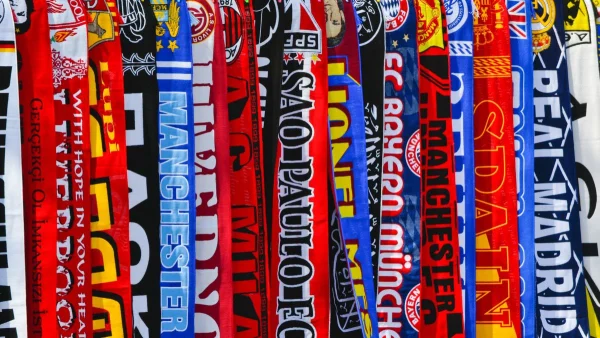
The first documented appearance of a recognizable soccer scarf comes from a 1934 British Pathé newsreel of an Arsenal versus Crystal Palace FA Cup match. In the footage, a single fan is wearing a scarf with alternating bands of color. That style became known as the “bar scarf” and it set the template for everything that followed.
From Warmth to Identity
As English clubs formalized their colors, the scarf followed. What started as cold weather gear became a way to show who you were with before the match even kicked off.
In the early days, fans dressed formally to attend games. Dark coats, flat caps, monochromatic everything. A scarf in club colors was one of the few ways to break from that and signal your allegiance from across the terrace. Ribbons and handkerchiefs did the same job for a while, but the scarf outlasted all of them.
By the 1960s and 70s, the shift was complete. Scarves were no longer about warmth. They were about identity.
Color photography changed things. Images of thousands of fans holding scarves above their heads, stretched between two fists, became some of the most iconic visuals in the sport. Newspapers and match programs ran those photos constantly. The raised scarf became shorthand for what it meant to be in the crowd.
Deirdre Clemente, a fashion historian and associate professor at the University of Nevada, Las Vegas, puts it this way:
"England was the powerhouse of textile production, and the scarf is the physical product of two things England does extremely well, produce knitwear and support soccer clubs."
That combination turned a simple piece of fabric into something that carried real meaning. Clubs started producing official versions. Supporters started collecting them. The scarf became a canvas for mottos, crests, rivalries, and memories. It stopped being something you wore and became something you kept.
Iconic Moments in Scarf Culture
Some moments in the sport are defined by what the fans did as much as what happened on the pitch. In almost every case, the scarves were part of it.
Liverpool FC
The Kop end at Anfield, red and white scarves held high, the entire stand singing “You’ll Never Walk Alone” in unison. That tradition started in the early 1960s and has been borrowed by clubs on every continent since. The original still hits different.
Celtic FC
The old standing section at Celtic Park known as “The Jungle” ran from 1966 to 1994. Thousands of green and white scarves twirling overhead created a visual that visiting clubs talked about for years. Home advantage before a ball was touched.
Boca Juniors
Copa Libertadores nights”at La Bombonera. The tradition is called el recibimiento “the welcome”. Teams walk out, the stadium detonates. Confetti, smoke, thousands of blue and gold scarves raised at once. The concrete shakes. European managers who have been there say nothing on their continent compares.
Borussia Dortmund
The “Yellow Wall” at Signal Iduna Park is 25,000 supporters in one stand, all in yellow and black, scarves raised together. One of the most photographed scenes in European soccer and a fixture since the 1970s.
Istanbul 2005
Champions League final. Liverpool down 3-0 to AC Milan at halftime. The scarves never came down. The singing never stopped. The comeback that followed is one of the most replayed sequences in the history of the sport, and every camera angle from that night shows the scarves first.
The American Chapter
American soccer did not inherit scarf culture the way English clubs passed it down through generations. It arrived differently. Supporters brought it here on purpose.
When Seattle Sounders FC entered MLS in 2009, their supporter groups carried a tradition that most American sports fans had never seen. Before kickoff, the entire north end of the stadium raised scarves overhead during the club anthem. “Scarves Up” became a ritual almost immediately. Within a few seasons, supporter sections across the league were doing the same thing.
But the roots go back further than MLS. The American Outlaws, the largest US national team supporter group, made the scarf part of showing up. Watch parties, away qualifiers, Gold Cup matches. If you were there, someone handed you a scarf. Not sold. Handed. Mine came that way at a watch party in Los Angeles before a US versus Belgium match. No transaction. No merchandise table. Just a fan from the group handing it over because I showed up first.
That is how a lot of American fans got their first scarf. Not from a team shop, bu from another fan who sucked you in.
Portland built one of the most visible scarf cultures in the country. The Timbers Army treated scarves the way European ultras did, as identity, not merchandise. Atlanta United launched in 2017 and sold out a 70,000 seat stadium with scarves everywhere from day one. It was not a tradition they inherited. They built it in real time.
Then there is the lower leagues. Clubs like Detroit City FC and Chattanooga FC started designing scarves before they had permanent stadiums. For those communities, the scarf was the first piece of proof that the club was real. Fans wore them to local bars, to pickup games, to other sporting events. The scarf said “this club exists and I am part of it” before the rest of the city even knew there was a team.
The American version of scarf culture did not come from grandmothers knitting at home. It came from supporter groups deciding that this is how we show up. That is a different origin story, but the result looks the same. A piece of fabric that means more than what it is made of.
What the 2026 World Cup Changed
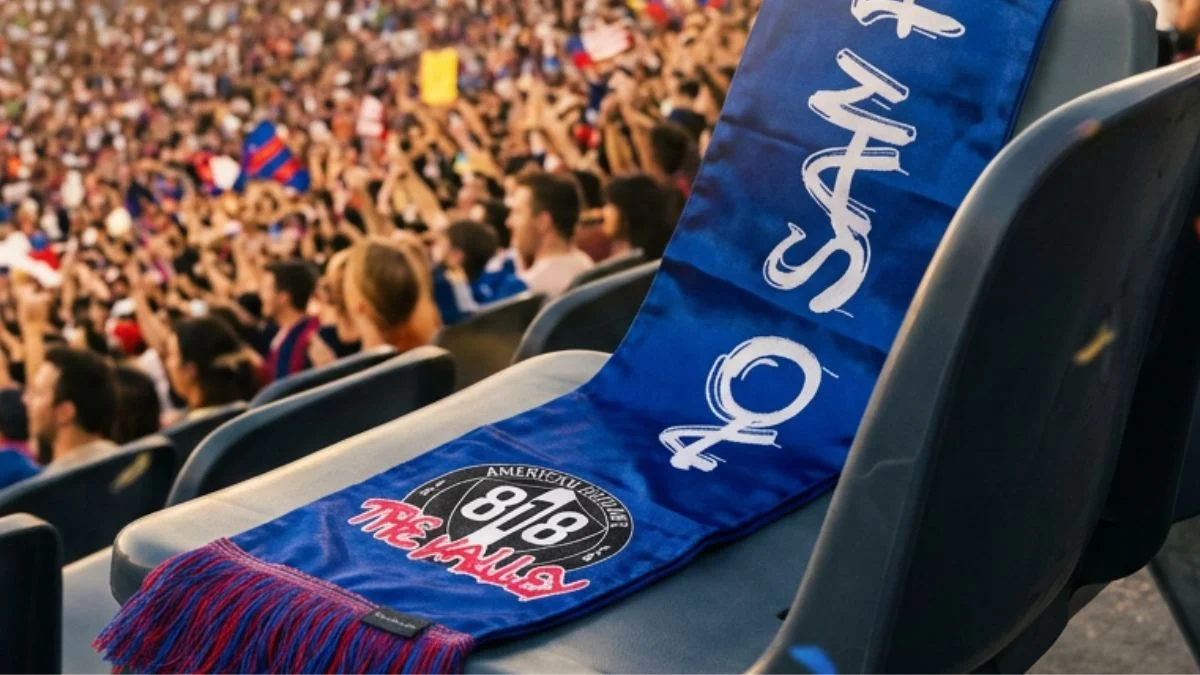
The 2026 World Cup in the United States, Canada, and Mexico likely put more scarves in American hands than any event in the history of the sport here.
Some of those fans had been collecting for years. But a lot of them picked up their first scarf at a watch party, outside a stadium, or from a supporters group table at a bar they had never walked into before. That is how it starts for most people. Not a planned purchase. A moment.
The tradition that began with grandmothers knitting wool in club colors for cold English terraces landed in 16 host cities across three countries at once. Fans from around the world brought their scarves with them. And thousands of American fans raised one for the first time.
What happens next is the part that matters most. A scarf from one summer becomes something else when you keep it. It goes on the wall next to the one from your local club. Your kid pulls it out of a drawer three years from now and asks what game it was from.
That is how scarf culture works. It starts with one. The story builds from there.
Start your Own Collection
Every scarf in a collection tells a story. Here is where to go next.
- Soccer Scarves: The American Fan’s Complete Guide: building a collection that means something
- Types of Soccer Scarves: knit, woven, printed, and how to pick the right one
- National Team Soccer Scarves: for the country you root for
- How to Display Soccer Scarves: getting them on the wall the right way